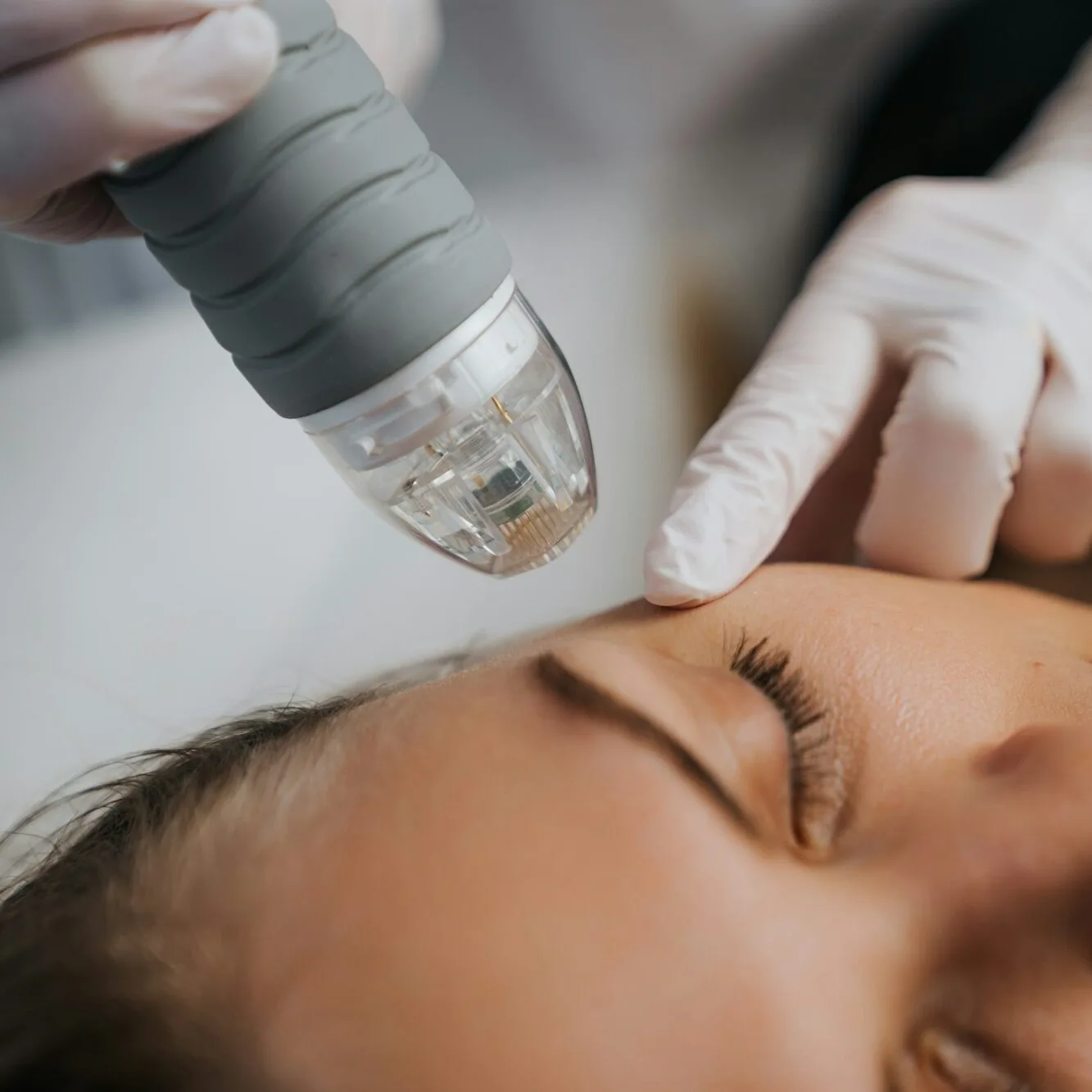
Dermaplaning sounds either clinical or alarming depending on how it is described. In practice it is a sterile surgical blade held at an angle, drawn across taut skin in short strokes.
It removes the outermost layer of dead skin cells and the fine vellus hair on your face. That is the whole treatment.
Why people love it
Makeup application changes immediately. This is the reason most people come back. Foundation stops catching on peach fuzz and sits flat.
Product absorption improves. Removing the dead cell layer means whatever you apply afterward actually reaches living skin.
Instant smoothness. You will touch your own face for the rest of the day. Everyone does.
No downtime. You leave slightly pink at most and it settles within an hour.
It stacks well. Dermaplaning before a hydrating treatment or a serum infusion gets more out of both.
The hair question
No, it does not grow back thicker or darker. This is the single most common concern and it is not correct.
Vellus hair is genetically determined in thickness and color. Cutting it does not change either.
What is true is that the regrowing hair has a blunt cut end rather than a naturally tapered tip, so for a few days it can feel slightly coarser to the touch. It looks the same and it returns to normal.
Who should skip it
Active acne. Dragging a blade across inflamed pustules spreads bacteria and can worsen breakouts. Congested skin without inflammation is fine. Active cystic acne is not.
Very oily skin. The blade does not glide well and results are less impressive. A different exfoliation approach works better.
Active eczema, psoriasis or dermatitis in the treatment area. Wait until it clears.
Recent isotretinoin use. Most protocols call for six months off.
Cold sore outbreak. Wait.
Terminal hair rather than vellus hair. If you have coarse, dark facial hair, this is not the right treatment and it may cause irritation or ingrowns. That is a different conversation.
Anyone with a keloid tendency or extremely thin, fragile skin. Ask first.
How often
Every four weeks is the standard cadence, matched to the skin cell turnover cycle.
More frequently than that is over-exfoliation and it will compromise your barrier, which in a Phoenix winter with humidity in the teens is a fast route to tight, flaky, reactive skin.
The at-home version
Those small facial razors sold in packs are not the same tool and they are not held at the same angle.
If you use them, use them on clean dry skin, use a fresh one each time, never on active acne, and follow with moisturizer. And accept that the result is a fraction of what a professional treatment produces, because the blade quality and the technique are different.
Never use one before a treatment appointment. Tell your provider if you have used one recently.
Aftercare
Sunscreen. Mandatory, and more so than usual since you just removed a protective layer. Our winter UV index still hits 5 and 6.
No actives for 24 hours. No retinol, no acids, no vitamin C.
No aggressive scrubbing for a few days.
Where it fits with other treatments
It pairs well as an add-on to a signature facial.
It should not be done in the same appointment as microneedling, and generally not in the week before one. Two exfoliating treatments too close together is more than skin needs.
Do it seven to ten days before an event, not the day before.
Add it to your next facial
Book a facial and mention dermaplaning when you schedule so we allot the time.