The reason assisted stretching works better than stretching on your own is simple and slightly counterintuitive.
When you stretch yourself, you are contracting one set of muscles to lengthen another. The muscle being stretched is never fully relaxed, because you are actively holding a position.
When someone else moves your limb, you can genuinely let go. That changes what is possible.
What a session looks like
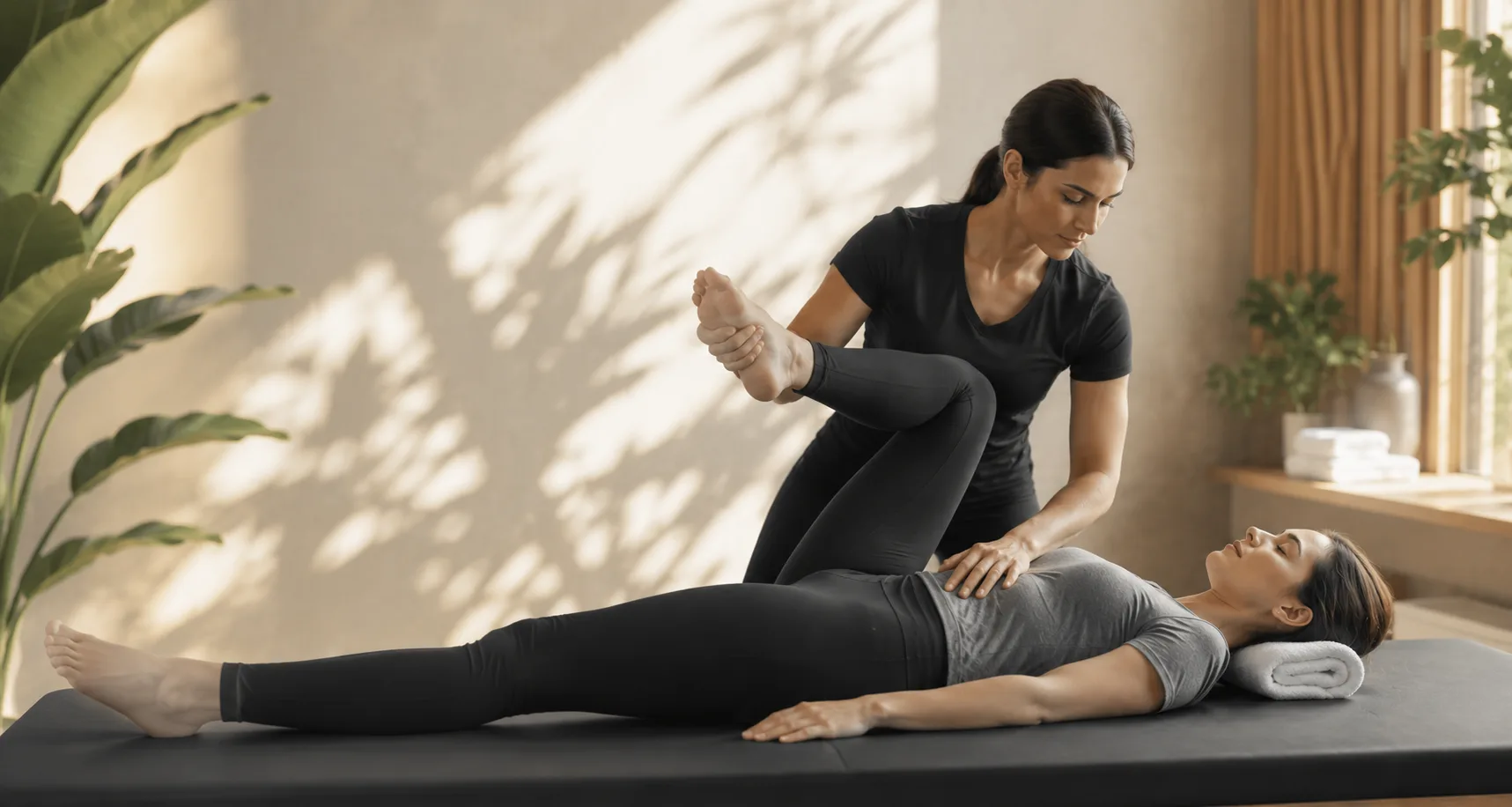
You are on a padded table, clothed, in something you can move in. Athletic wear, not jeans.
A practitioner moves you through a sequence of positions, holding each while you breathe. They are watching your range, feeling for resistance, and adjusting pressure based on what your tissue is doing rather than a fixed script.
Most sessions work through hips, hamstrings, glutes, low back, shoulders and neck. If you have a specific complaint, say so at the start and the session gets built around it.
What it feels like
Not painful. Firm, and occasionally intense at the edge of a range, and never sharp.
There is a specific sensation when a chronically tight area finally releases that people struggle to describe. Somewhere between relief and mild alarm.
You will be asked to breathe out at particular moments. That is not decoration. Exhaling reduces neuromuscular guarding and it is the difference between a stretch that works and one that fights you.
You will probably talk less than you expect. Most people go quiet about ten minutes in.
Who it helps most
Desk workers. Hip flexors shortened from eight hours of sitting, thoracic spine locked up, shoulders rounded forward. Extremely common and extremely responsive.
Runners and cyclists. Repetitive movement in a narrow range creates predictable tightness.
Anyone over forty who has stopped moving as much. Range of motion declines quietly and you notice it when you reach for something.
People with chronic neck and shoulder tension. Often the same people getting tension headaches.
Golfers. Rotational demand plus a lot of standing. Phoenix has no shortage of these.
What it is not
It is not physical therapy. We are not diagnosing or treating injuries.
It is not massage, though it is adjacent and both are useful.
It is not chiropractic. Nothing gets adjusted or manipulated in that sense.
If you have an acute injury, a recent surgery, a disc issue, or pain that is sharp or radiating, see a physician or a physical therapist first. Bring their guidance and we will work within it.
Afterward
Most people feel looser immediately and notice it most the next morning.
Mild soreness the following day is normal, similar to after a good workout. Tissue was worked.
Hydrate. Move a little that evening rather than sitting still.
The effect fades over days to weeks depending on what you do in between. Sessions plus a small daily practice at home beats sessions alone by a wide margin.
How often
Every two to four weeks for maintenance.
Weekly for a stretch if you are working through something specific, then back off.
Pair it with compression therapy if you train, since they solve different problems. Compression moves fluid, stretching addresses tissue length and range.
Pricing is by inquiry. Call (602) 391-8889 or ask when you book.
Book a session
Schedule assisted stretching in North Phoenix.