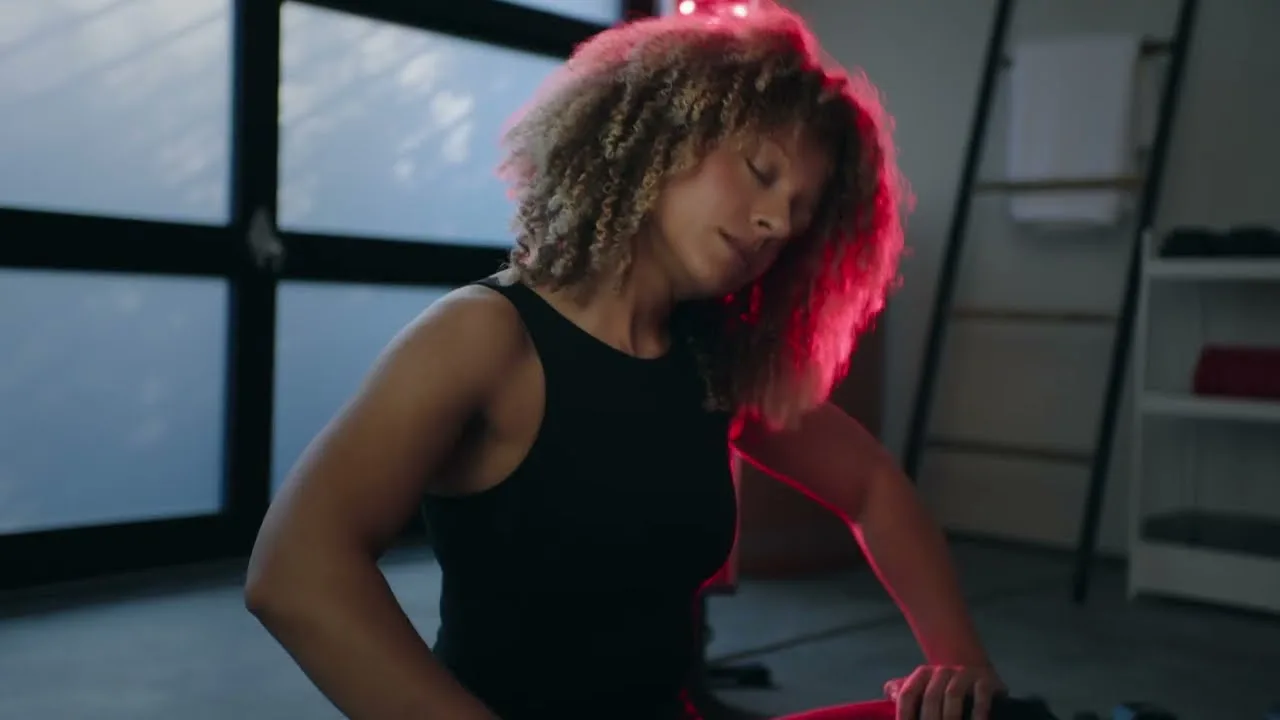
Red light therapy is sold as a fix for skin, hair, pain, sleep, weight, mood and inflammation. When something claims everything, sensible people assume it does nothing.
It does a few things well. It does a few more things maybe. And a lot of what is written about it is marketing. This is the whole picture as we understand it, with the numbers, so you can decide whether it belongs in your routine and how to use it if it does.
What it is
Red light therapy, or photobiomodulation if you want the research term, is exposure to specific wavelengths of light at an intensity that does not heat or damage tissue. Two bands do the work: red, around 630 to 660 nanometers, and near-infrared, around 810 to 850. Our Clearlight tower runs 70 LEDs at 650nm and 70 at 850nm.
Red light is absorbed in the first few millimeters of skin. Near-infrared goes deeper, into muscle and joint tissue. You can see the red. The near-infrared is invisible, so when half the diodes on the tower look dark, they are working.
The working theory is that these wavelengths are absorbed by an enzyme in your mitochondria, which nudges cells to produce more ATP, the energy they run on. Cells doing repair work get more to work with. That is the mechanism behind every real benefit on the list below, and it is also why the benefits are gradual. You are supporting a process, not forcing one.
No UV. It cannot tan you, burn you or age your skin. A 2025 consensus from a 21-member international expert panel, published in the Journal of the American Academy of Dermatology, concluded that red light photobiomodulation does not cause DNA damage and is a safe modality for adults.
What the evidence supports
Collagen, fine lines and skin texture. The best trial is still a 2014 controlled study of 136 volunteers who used red and near-infrared light twice a week for 30 sessions. Compared with the untreated group, they showed higher collagen density on ultrasound, smoother skin on profilometry, and visibly fewer fine lines in blinded photographs. Results vary, and the effect is modest and slow. Nobody in that study looked different after two weeks. They looked different after thirty sessions. We wrote up the skin evidence in more detail in Red Light Therapy for Skin: What Research Supports.
Post-procedure healing. Wound healing is one of the applications the expert panel endorses outright, and it is why we put clients under the light after microneedling, peels and Morpheus8. The pink phase runs shorter. This is the most reliable thing red light does.
Muscle soreness and recovery. A 2025 systematic review pooled trials of light therapy applied after exercise, at wavelengths between 660 and 950nm. Soreness was moderately lower at 72 and 96 hours, and strength came back substantially faster at 24 and 48 hours. Only four of the fourteen studies had data clean enough to pool, so hold it loosely, but the direction was consistent across the rest. If you train hard, this is the benefit you will notice first.
Inflammation and redness. Reasonable evidence for calming inflamed skin, which is the same mechanism as the healing effect.
Where it is thinner
Hair. The expert panel does endorse red light for pattern hair loss, and that is real. But those studies use scalp devices with specific parameters, used daily for many months. Our tower is not a hair device and we will not sell it as one.
Sleep. One small 2012 study gave twenty athletes 30 minutes of whole-body red light every night for two weeks. Their melatonin went up and their sleep scores improved. Interesting. Twenty people, two weeks, one study. Not a reason to book.
Pain. There is decent support for light therapy in some nerve and joint pain, which is why physiotherapists use it. We offer red light as a wellness service, not a medical treatment. If pain is the goal, talk to your doctor about whether a clinical protocol makes sense.
Fat loss, cellulite, detox, mood, hormones. No. Some studies exist for some of these. The effects are small, the methods are inconsistent, and we do not make these claims.
Why more is not better
This is the part most articles skip and the part that matters most.
Light therapy has a biphasic dose response. Too little does nothing. The right amount stimulates cells. Too much suppresses them and the benefit falls off. It has been documented in cell studies since 2009 and it shows up in clinical dosing too.
Practically: a 10 to 20 minute session at the right distance is the useful range. Forty minutes is not twice as good. It is probably worse. If you are going to spend money on this, spend it on frequency, not duration.
Home masks versus a clinical tower
The number that matters on any device is irradiance: how much light actually lands on your skin, in milliwatts per square centimeter, at a stated distance. Most consumer masks either do not publish it or publish a figure in the low tens. Because a mask sits directly on your face, that can still add up to a workable dose over enough sessions, and a good mask used nightly is a reasonable tool for your face.
The Clearlight tower is rated at 110 mW/cm² close up. That is a different category of output, and it covers your whole body at once: back, shoulders, legs, hips, everything a mask never touches. If your goals are muscle recovery, or anywhere other than your face, a mask cannot do the job at all. That is what the tower is for.
If you have a mask, keep using it. Many of our members do both.
How often, and for how long
Frequency beats duration, so build the schedule around showing up.
Starting out: three to five sessions a week. Clearlight's own guidance is daily at first, tapering to three or four times a week. The best skin trial used two sessions a week and ran for thirty sessions.
Give it eight to twelve weeks before you judge the skin effects. Collagen turns over slowly. Muscle recovery you will feel within the first week if you are training.
Maintenance: two to three sessions a week holds what you built.
Each session: 10 to 20 minutes standing about six inches from the tower, or 20 to 30 minutes seated a little further back. Clean, bare skin on the areas you want treated. No lotion, makeup or sunscreen on those areas beforehand, because anything sitting on the skin sits between the light and the skin. Sunscreen goes on when you leave, because this is Phoenix.
Stacking it with sauna, cold plunge and compression
There is a tower in each of our two private sauna rooms, and red light is included in the same membership as the infrared sauna, cold plunge, hot tub and compression. So the obvious question is what order to do them in.
There is no trial on sequencing, so this is practical logic, not evidence.
Cold plunge first, heat second, red light last. Cold constricts blood flow to the skin, which is the opposite of what you want while the light is on. Heat brings it back. Red light on warm, dry, bare skin at the end is also the most pleasant way to finish, and it happens in the same room as the sauna, so there is nowhere to walk.
Compression before or after, your choice. It does not interact with the light either way. Most people do it last because it is the one where you lie down.
After a workout, not before. Every study in the soreness review applied the light after exercise. Pre-workout light has fans, but the recovery evidence is for afterwards.
A full recovery visit runs about an hour: a few minutes in the plunge, twenty in the sauna, fifteen under the light, then compression if you want it.
Who should check first
Red light is gentle and most people tolerate it without a second thought. A few should ask before booking.
Photosensitizing medication. Some antibiotics (doxycycline and the tetracycline family in particular), isotretinoin and other oral retinoids, some diuretics and blood pressure drugs, and St. John's wort can make skin react to light. If you take any of these, check with the prescriber first. Topical retinol makes skin more sun-sensitive, and red light has no UV, so most people are fine. Tell us if your skin is reactive.
Photosensitive conditions. Lupus, porphyria, or a history of blistering or burning from ordinary sun exposure. Talk to your doctor.
Active skin cancer or a suspicious lesion in the treatment area. Do not treat over it.
Pregnancy. The evidence points to safe, and it is widely used on the face and limbs. Ask your OB about the abdomen and lower back, because that is where the data is thin.
Eyes. The light is bright. Do not stare into the diodes. Close your eyes or use the eyewear we provide.
First time and not sure how your skin reacts? Ask us for a short patch test on a forearm before the full session. It takes three minutes.
What a session here is like
You book 30 minutes. You get a private sauna room with the tower in it. Undress to whatever you are comfortable with, so the areas you care about are bare. Set the timer, close your eyes, and sit or stand in the light. It feels like mild warmth and not much else, which is why people are skeptical. There is no sensation that tells you it is working. The evidence is the only thing that does.
Book it on its own, or add it to a sauna session and finish under the light. Afterwards: sunscreen, water, and the rest of your day. There is no downtime and nothing to avoid.
The cost math
Sessions are $40. Three sessions a week for the eight weeks it takes to judge the skin effect is 24 sessions, or $960 at the drop-in price.
The Monthly Membership is $149 and includes daily red light plus the infrared sauna, cold plunge, hot tub and compression. Two months of it is $298, and you get the rest of the recovery floor with it.
If you are going to do this properly, meaning often, there is no version of the math where paying per session makes sense. If you want to try it once to see what it feels like, $40 is the way to do that.
Try a session
Book red light therapy in North Phoenix, or ask us about the membership at your next visit.